Ethereum Application Gathering Highlights the Next Chapter for Ethereum Applications (Part II)
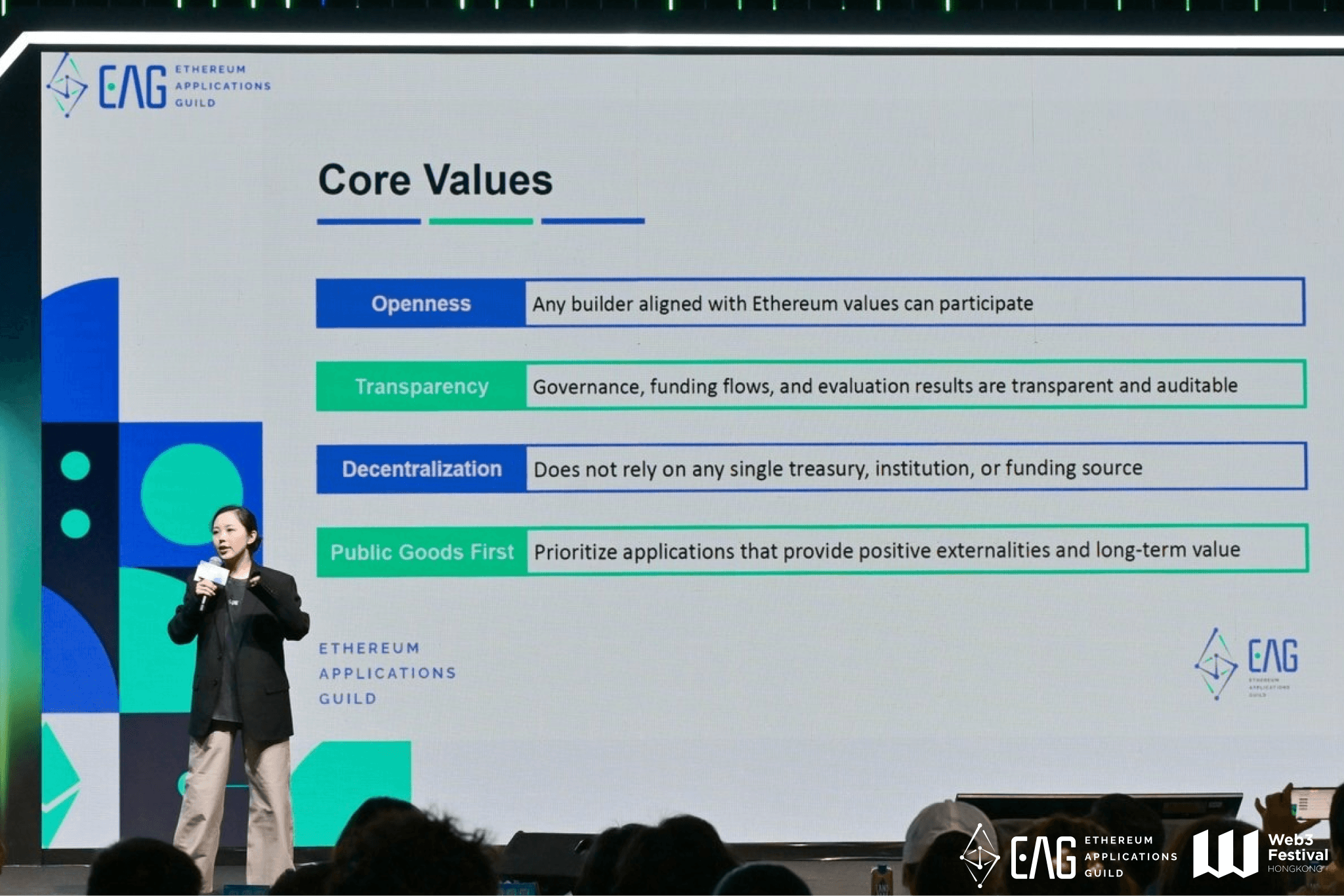
Audrey Tang: Towards Real-World Applications
Audrey Tang, Executive Director of Ethereum Application Guild (EAG), introduced the origins and mission of EAG, a non-profit initiated by long-term builders to accelerate innovation and real-world impact of Ethereum-native applications. She reflected on “ShanHaiWoo” pop-up residencies held over the past three years in cities such as ChiangMai and Singapore, highlighting a key gap between individual builders and mature projects, particularly around funding and scaling pathways.
To address this structural gap, EAG focuses on four key areas: accelerating real-world application development, connecting a cross-disciplinary builder network, supporting shared evaluation and development frameworks, and establishing sustainable funding mechanisms. EAG is establishing sustainable funding mechanisms through two primary pathways: membership contributions and staking rewards contributed by ETH holders, which are used to support the long-term development of the Ethereum application ecosystem.
Audrey has also introduced the 2026 Global Application & Builder Initiatives as a structured set of regional programs supporting developers in emerging and underrepresented regions. From May to September 2026, these initiatives will be carried out across Latin America, Africa, Oceania, and India through developer education, hackathons, selection tracks, as well as academic and research sessions, aiming to strengthen local builder communities and support the development of regionally relevant applications.
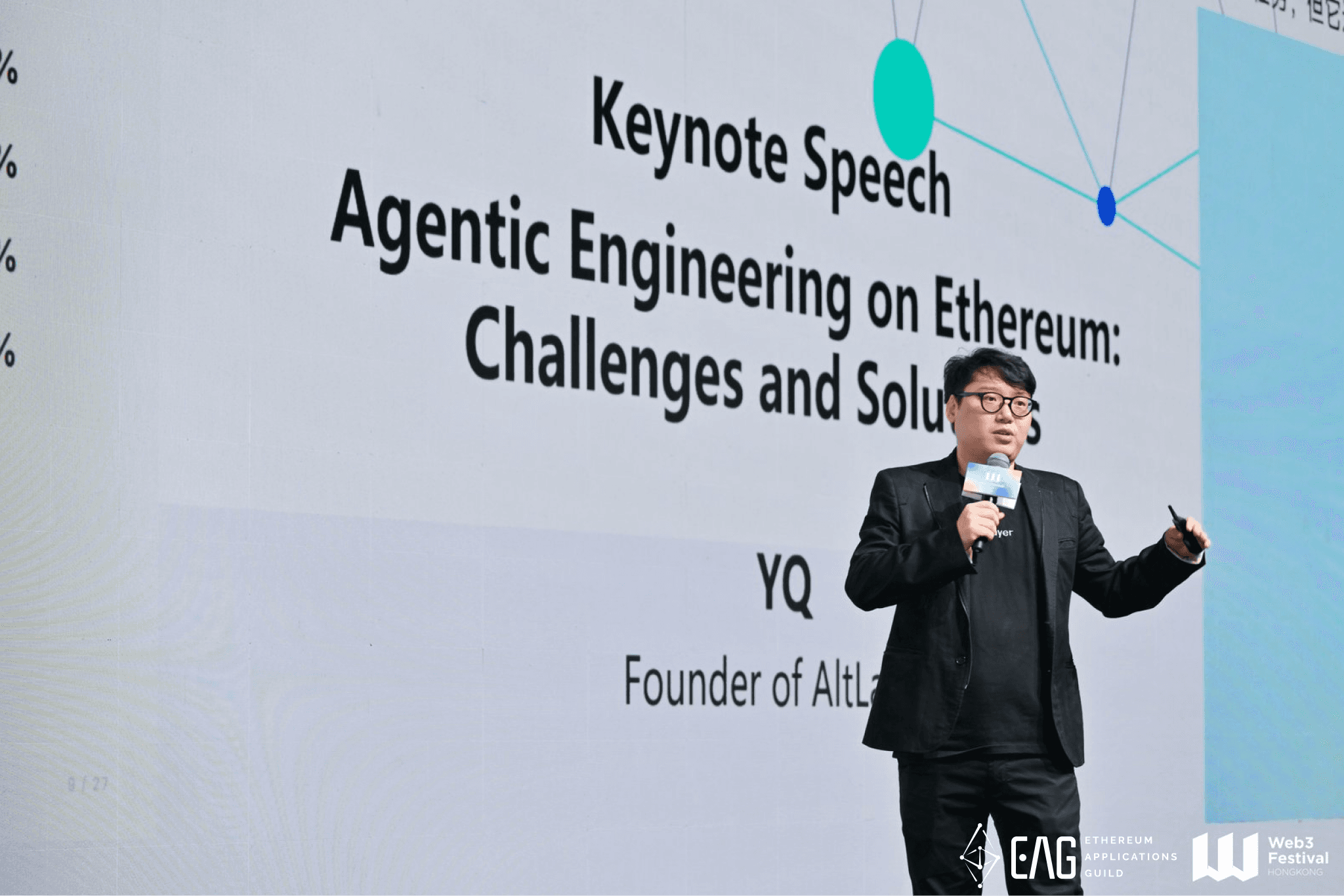
YQ: Agentic Engineering on Ethereum: Challenges and Solutions
The founder of AltLayer YQ shared an “ETH2030” experiment where AI Agents rebuilt an Ethereum client in one week, integrating account abstraction, ZK, and post-quantum features. While code generation took only six days, debugging and deployment required another month, revealing limits in current AI systems such as context constraints and “silent failures”.
He introduced AltLayer’s Agentic-era stack, including 8004scan.io, cryptoskill.org, AltLLM, and developer tools like Alt Code CLI and Cloud Claw. He argued that agents are productivity amplifiers, enabling up to 100x efficiency gains for builders.
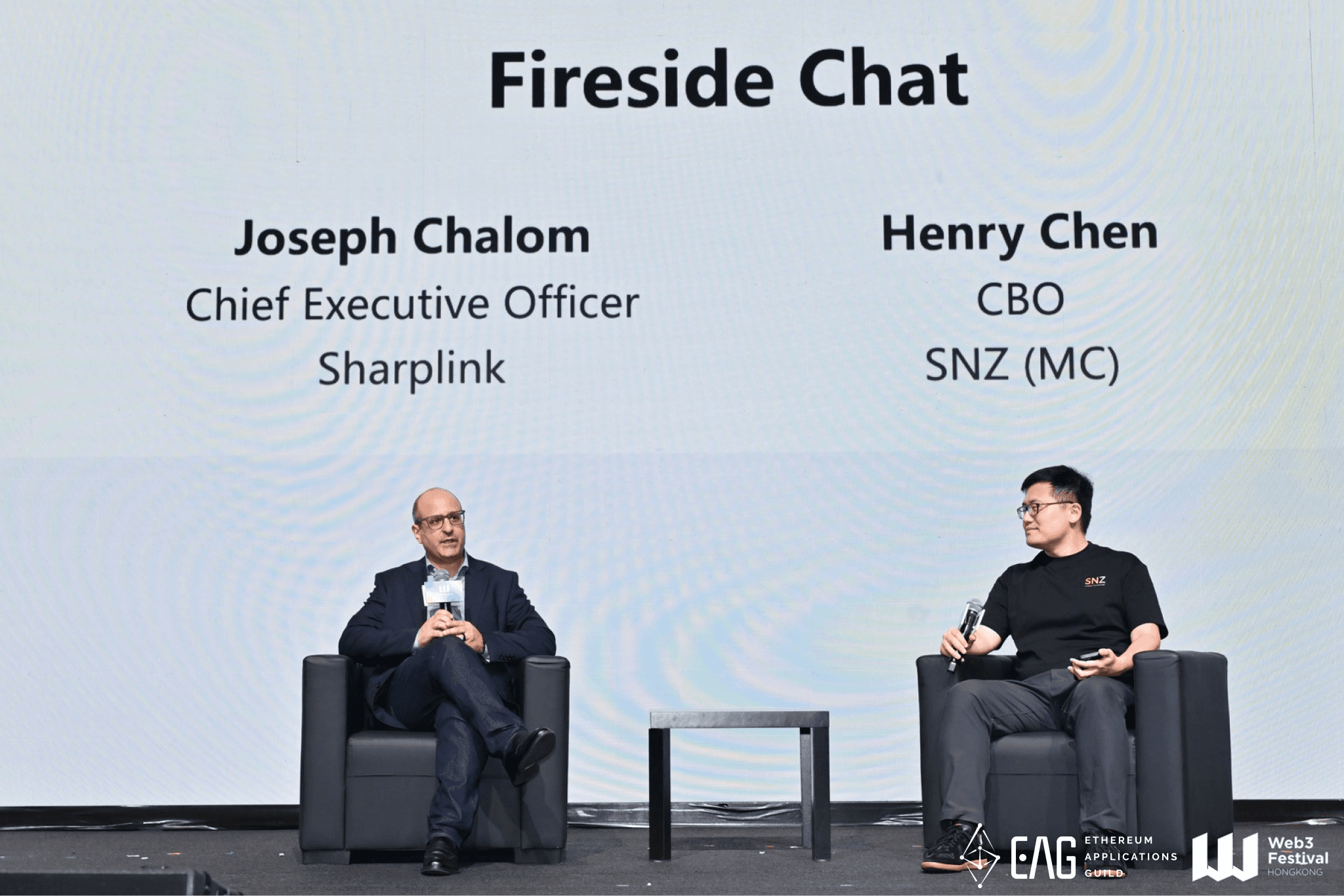
Joseph Chalom: From Institutional Ethereum Adoption to the Agent Economy
Sharplink CEO Joseph Chalom joined Henry Chen, CBO of SNZ, in a conversation on Ethereum’s institutional adoption path and the future of an “Agent Economy” driven by AI Agents.
Joseph, after leading initiatives such as USDC reserve management, Bitcoin and Ethereum ETFs, and tokenized real-world asset funds at BlackRock, founded Sharplink as the first Ethereum-focused digital asset treasury company. Unlike Bitcoin treasuries, Joseph’s Sharplink treats ETH as a productive asset combining value storage with staking yield and operates with a long-term “permanent capital” structure, staking nearly all ETH holdings to generate on-chain revenue while reinvesting into the ecosystem.
Joseph emphasized Ethereum’s role as the foundation of future capital markets, where stablecoins become the core payment layer and tokenized assets such as stocks and bonds operate 24/7 on-chain. Looking ahead, he believes AI agents will reshape financial behavior by autonomously managing portfolios, optimizing yields, and executing transactions through integrated wallets linked to both bank accounts and crypto infrastructure. In this agent-driven economy, individuals will interact with a “digital twin” that executes financial goals in real time, shifting finance from human execution to machine-driven capital systems powered by Ethereum.
Michael: Build Next-gen dApp with The Infinite Compute Layer
Michael, Co-Founder & CEO of Brevis argues that the core limitation of blockchain today is not decentralization, but the extremely high cost and redundancy of computation. Because every node must re-execute the same operations, blockchain systems are inherently inefficient, making complex financial logic and advanced applications difficult to scale. Brevis addresses this by introducing a zero-knowledge proof–driven verifiable computation layer. The architecture decouples computation from verification: it moves heavy and complex computational logic off-chain, while only submitting concise ZK proofs on-chain, thereby enabling the blockchain to achieve “infinite” processing capacity.
At the application level, Michael highlights how this architecture extends beyond DeFi into AI, privacy systems, and real-world data verification. Examples include device-level cryptographic attestation for proving content authenticity against AI-generated media, privacy-preserving DeFi protocols, and incentive systems based on verifiable user behavior. He believes that in the next decade, most blockchain computation will move offchain, but remain fully secure through ZK proofs. In this vision, Brevis becomes a verifiable computation layer powering the next generation of scalable, trustless, and highly complex decentralized applications.
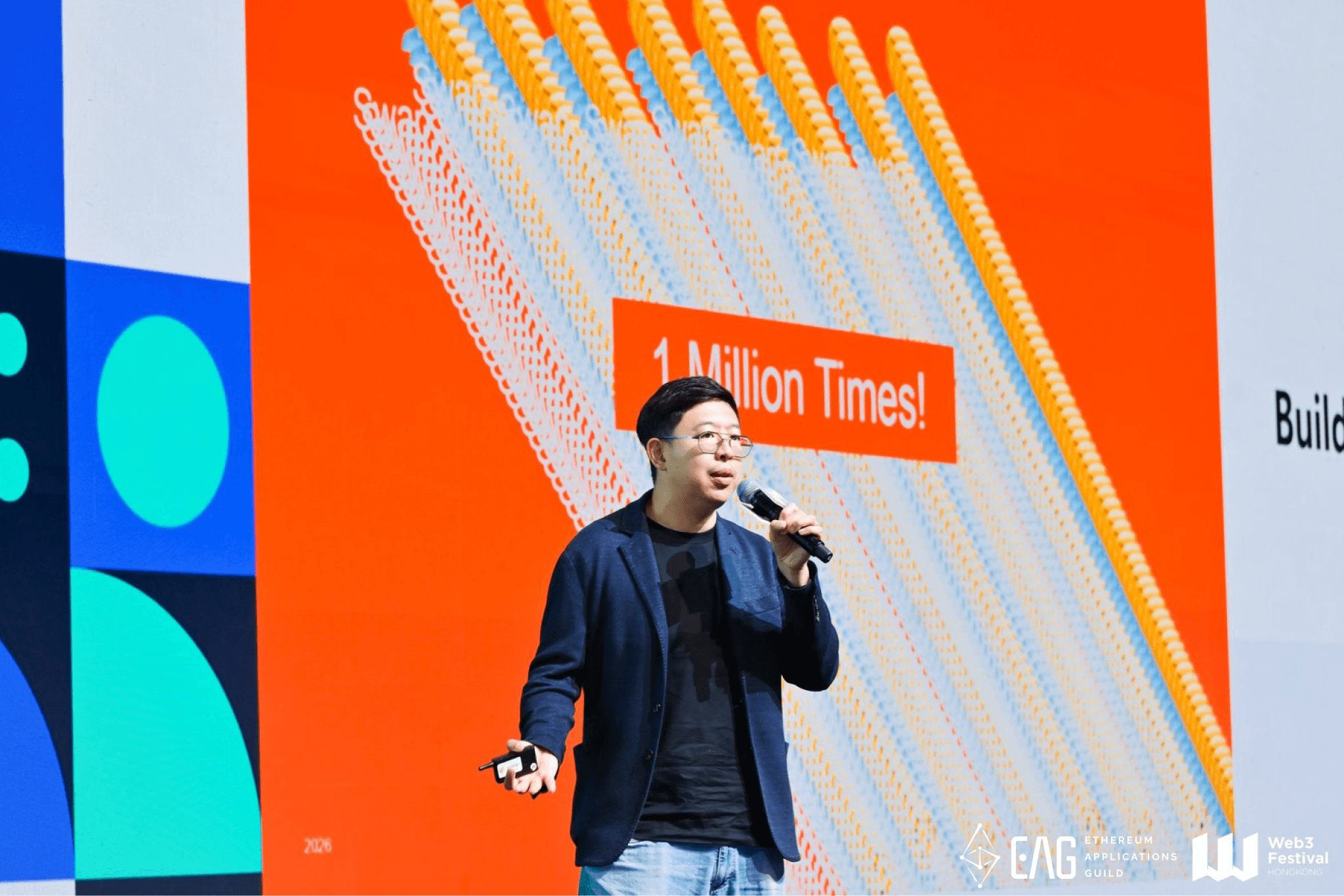
Tina Zhen: Application Controlled Execution: Ethereum competitiveness from DeFi to Fintech to Agentic Applications
Tina Zhen, Co-founder & Steward at Flashbots, framed the evolution of applications around a central question: how to preserve human agency in an increasingly agent-driven and off-chain-heavy computing world. She argued that applications have always followed a simple structure of input, logic, and outcome, but what has fundamentally changed is who controls execution. With computation increasingly moving off-chain through verifiable infrastructure, she emphasized that decentralization itself is not the end goal; rather, the goal is ensuring users retain meaningful control and verifiable outcomes over their intents.
Looking ahead to agentic applications, Tina highlighted the need for accountable execution systems that extend blockchain’s guarantees beyond transactions into multi-step agent behavior, ensuring bounded authority, verifiable execution, and transparent coordination in a future where AI agents act on behalf of users.
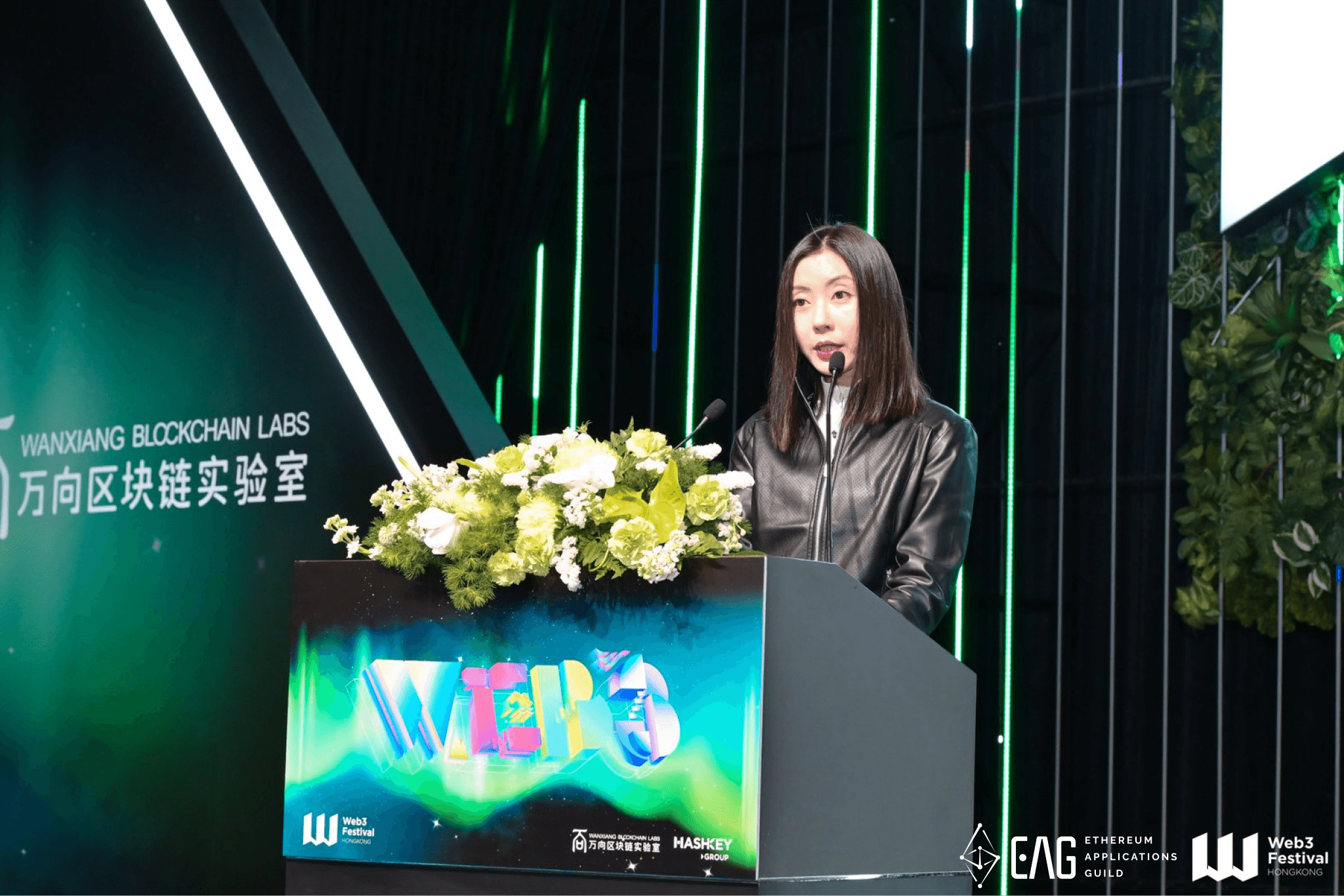
Institutional Adoption on Ethereum: Challenges, Gaps, and the Path Forward
In the context of Ethereum gradually moving toward institutional-grade adoption, this panel discussion explores its core challenges, real-world gaps, and future trajectory. QZ, Partner of Ethereum Ecosystem Fund, notes that institutional adoption of Ethereum is not merely a validation of its technology, but rather a reinterpretation and integration of its capabilities within existing financial systems shaped by compliance constraints and risk management frameworks. He suggests that this form of adoption often aligns more with traditional financial logic than with crypto-native ideals of decentralization. Therefore, the key question is how Ethereum can adapt to large-scale institutional participation while still preserving its core properties of openness, verifiability, and decentralization.
Patrick McCorry, Researcher at Arbitrum Foundation, argues that the main obstacle to institutional adoption is not Ethereum’s underlying technology but its user experience. DeFi was built for crypto-native users, resulting in tools like hardware wallets, multisigs, and transaction simulations that are too complex for traditional finance participants. As real-world assets and institutional capital enter Ethereum, this UX gap becomes critical. He emphasizes that institutions want clarity, recoverability, and familiar financial workflows, and the next major challenge for the ecosystem is redesigning wallets and transaction interfaces to reduce friction and counterparty dependency.
Mo Jalil, Institutional Privacy Lead at Ethereum Foundation emphasizes that institutional adoption should start from understanding institutional needs rather than pushing Ethereum directly. Different institutions care about different problems such as payments, identity, and settlement, while Ethereum provides a neutral, censorship-resistant, and verifiable infrastructure. He highlights that education and translation are essential because they help institutions understand not just what Ethereum is but also what additional guarantees it provides. He also notes that institutions already value these properties, and the real task is bridging the communication gap between Ethereum’s technical language and institutional priorities.
Serena Wang, Head of HSK Eco Labs at HashKey Group explains that institutions primarily focus on compliance, accountability, and regulatory clarity when evaluating Ethereum. Their first questions are typically about decentralization, responsibility in case of failure, and legal traceability. HashKey addresses this by embedding compliance directly into infrastructure design, making regulatory alignment a native feature rather than an afterthought. She highlights that institutional adoption is driven less by ideology and more by safety, KYC/AML requirements, and government expectations. HashKey’s role is to bridge traditional finance and crypto through compliant, institution-friendly infrastructure.
Samuel Chong, Institutional Relations Lead APAC & MENA at Lido Ecosystem Foundation explains that institutions adopt DeFi primarily for liquidity optionality, including faster withdrawals and yield enhancement opportunities. Institutional adoption typically begins with regulated custody solutions before gradually moving into liquid staking and deeper DeFi integration. Lido’s focus on decentralization, security, and transparency makes it a foundational liquidity layer for institutional participation in Ethereum.
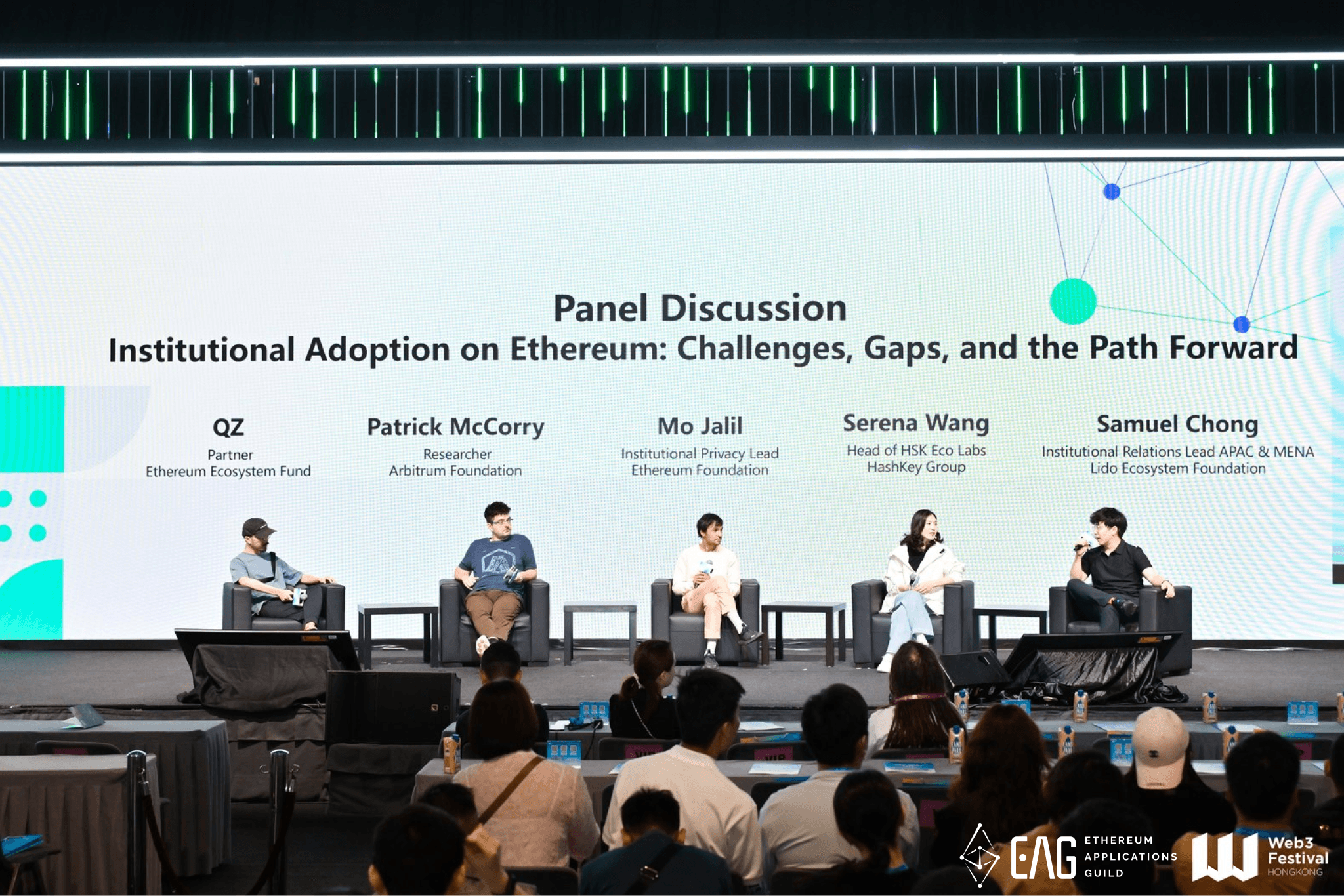
Ethereum Meets Hardware: From Devices to Autonomous Systems
In the panel “Ethereum Meets Hardware: From Devices to Autonomous Systems,” speakers discussed how Ethereum is extending into physical hardware systems and how such integration can be realized.
Leo Lin, Co-founder of Arkreen argued that the convergence of Ethereum and hardware is driving a shift from a software-centric on-chain paradigm toward a machine-driven autonomous economy. Rather than simply bringing all devices or data on-chain, the real challenge lies in building a foundational coordination layer for machines, enabling robots, AI devices, and energy systems to share identity, trust, verification, and collaboration mechanisms. He emphasized that hardware–blockchain integration is now becoming a concrete design space, the industry is moving from device connectivity to autonomous system design, and the future machine economy will be fundamentally built around identity and coordination, with Ethereum and Web3 serving as the underlying infrastructure for coordination and rule enforcement.
Ben Zhai, CEO of Robo.ai argues that the traditional hardware was built for humans, not machine-native economies. The real opportunity is the emergence of a “machine economy” that connects smart mobility, smart machines, and blockchain into verifiable, autonomous, and open asset systems. Robo.ai is inspired to be the global pioneer in “Smart Open Machine Economy” and he calls for more strategic partners to join the race. Ben believes, just like O2O (Online to Offline) model playing a key role in innovation more than ten years ago,the upcoming “R2R” (Robot World to Real World) revolution will generate many powerful companies, and 2025 could be viewed as the founding era of R2R in the future.
Wallace Leung, General Manager (Hong Kong) at StarFive focuses on the performance gap between hardware and blockchain systems, especially in cryptographic computation at the edge. He believes open chip architectures like RISC-V will be critical infrastructure for enabling ZK proofs, off-chain execution, and on-chain settlement. He envisions a hybrid architecture where devices execute locally but settle on-chain, enabling autonomous asset cycles.
Nijika, Head Product Manager, Leaptic Tech argues that future hardware will evolve from passive recording tools into continuous intelligent data systems. Cameras, wearables, and AI devices will form a visual memory network that organizes and understands data automatically. He emphasizes that devices should have on-chain identity and wallets, enabling them to act as intelligent nodes in an open collaborative network.
Kelly Luo, VP of Faith Technology focuses on integrating energy systems with Web3. She explains that energy devices can generate verifiable on-chain carbon data, enabling carbon assetization, trading, and automated revenue sharing. This improves transparency and reduces operational costs. Her vision is for every energy device to become a node in a decentralized global energy network.
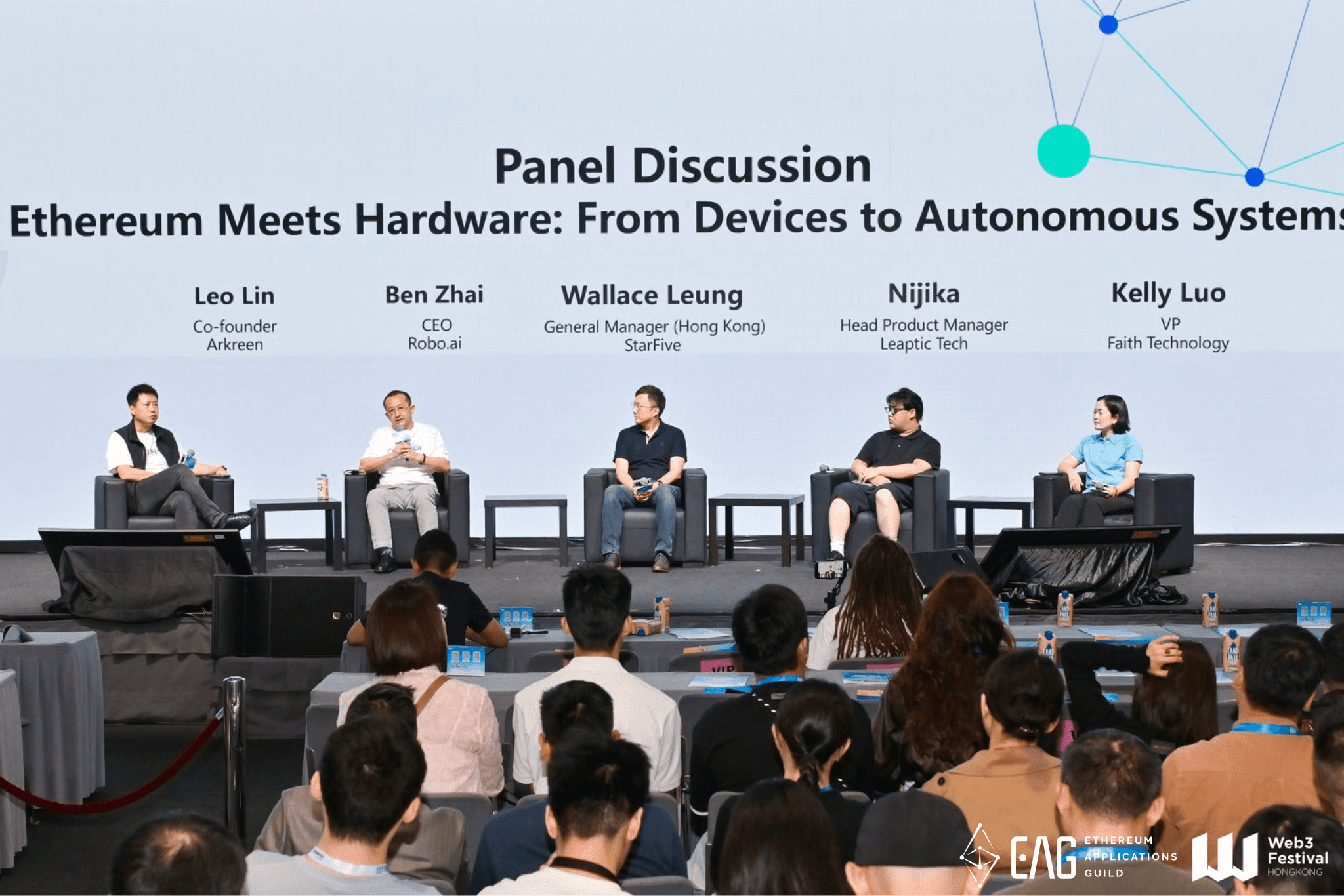
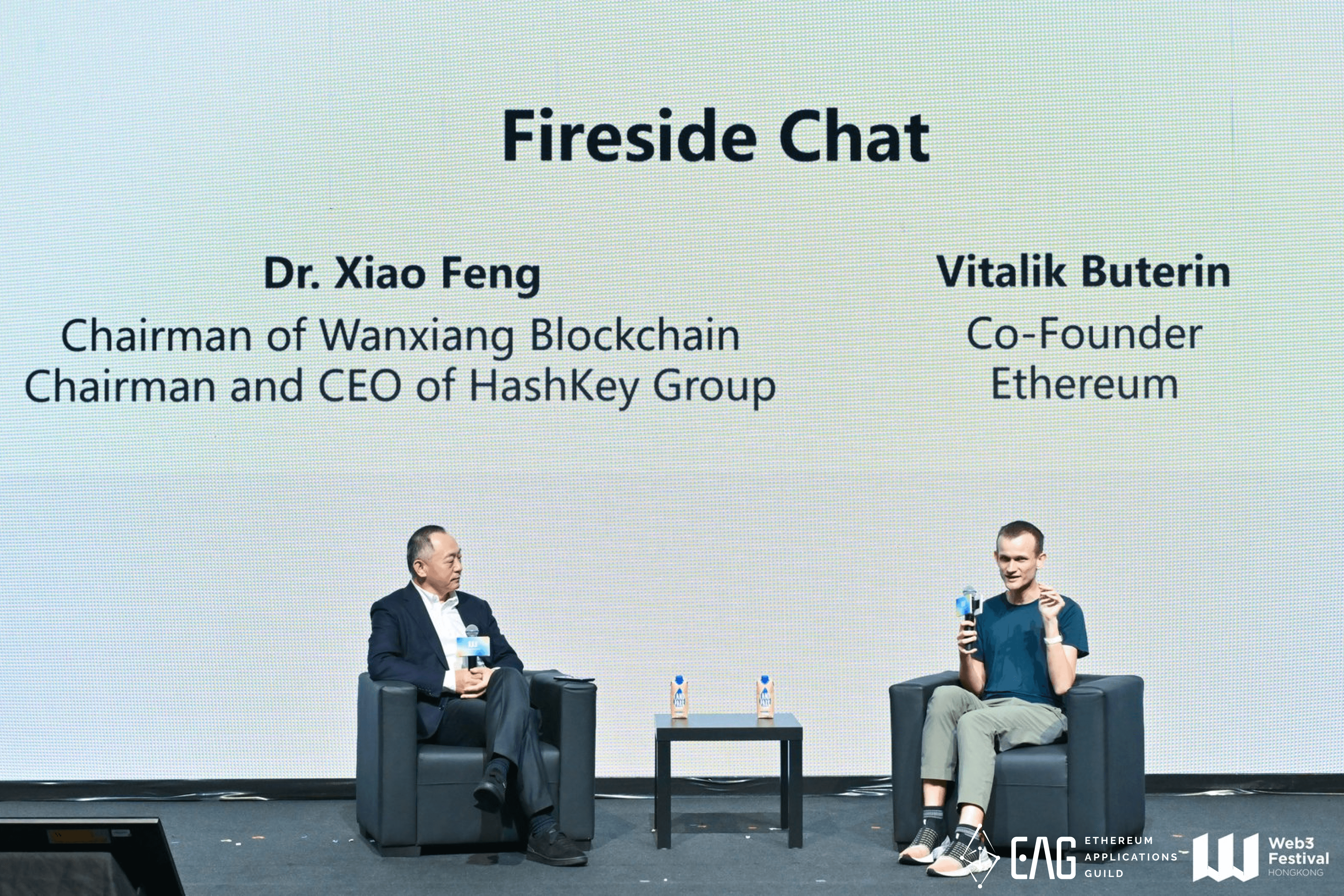
Vitalik Buterin: Toward Full-Stack Open Source Security and an AI-Driven Era of Soft Sovereignty
In the final fireside chat with Dr. Xiao Feng, Vitalik Buterin focused on the future direction of Ethereum and the growing importance of AI, hardware, security, and privacy-preserving computation in the blockchain ecosystem. He noted that Ethereum is rethinking the idea of “full-stack open source security,” meaning security should not be limited to the protocol layer but should extend across browsers, operating systems, hardware wallets, and even chip-level infrastructure. As blockchain applications increasingly move into the real world, hardware security and hardware acceleration will become foundational components that cannot be ignored. At the same time, he emphasized that Ethereum must continue to “simplify” in order to lower the barrier for both users and developers. Just as the internet evolved from command lines to GUIs and then to mobile apps, AI may usher in a new era of “natural language as the new command line,” where users can interact with complex systems simply through natural language, while AI wallets and AI-driven interfaces could become a key direction for on-chain interaction.
From a security and protocol perspective, Vitalik highlighted that AI is simultaneously enhancing and challenging blockchain systems. On one hand, AI can significantly improve formal verification, smart contract auditing, and core protocol development, making previously infeasible levels of verification possible. On the other hand, it also amplifies the capabilities of attackers and vulnerability discovery, meaning security is not only a technical issue but also a design choice made by developers. He noted that Ethereum’s next phase of development includes faster finality, quantum resistance, stronger decentralization, and improved protocol security, with increasing integration of AI and formal verification in these efforts. He also stressed that Ethereum’s core competitive advantage remains its security and trustworthiness, and that instead of competing on performance alone, Ethereum should focus on “things only Ethereum can do,” such as decentralization, security, privacy, and trustless infrastructure.
Regarding the convergence of privacy computing and AI, Vitalik stated that zero-knowledge proofs (ZK) have already reached a relatively mature stage, while fully homomorphic encryption (FHE) is developing rapidly and will soon become highly impactful. He believes that combining AI, FHE, and blockchain will unlock real-world applications in areas such as healthcare, IoT, and data collaboration, where both intelligence and strong privacy guarantees are required. Blockchain, in this context, can provide permissionless and trustless coordination for data and value exchange. He further explained that the Ethereum Foundation’s recent update to its mission and values reflects a commitment to maintaining decentralization, privacy, autonomy, and open collaboration in an era of rapid AI-driven transformation. He introduced the concept of “Soft Sovereignty,” arguing that future technology should not only improve efficiency but also empower users with true ownership and control over their assets, data, and digital lives, an idea that lies at the core of Ethereum’s long-term vision.
With the launch of the Ethereum Applications Guild (EAG), Vitalik noted that as the Ethereum ecosystem continues to expand, its long-term growth will increasingly depend on a broader range of independent organizations, developer communities, and application teams contributing across the broader ecosystem. He suggested that EAG may play a role in areas that are important for ecosystem development but not necessarily suited for direct Foundation involvement, including application-layer innovation, bridging traditional industries and blockchain industry, global developer coordination, and regional ecosystem growth.
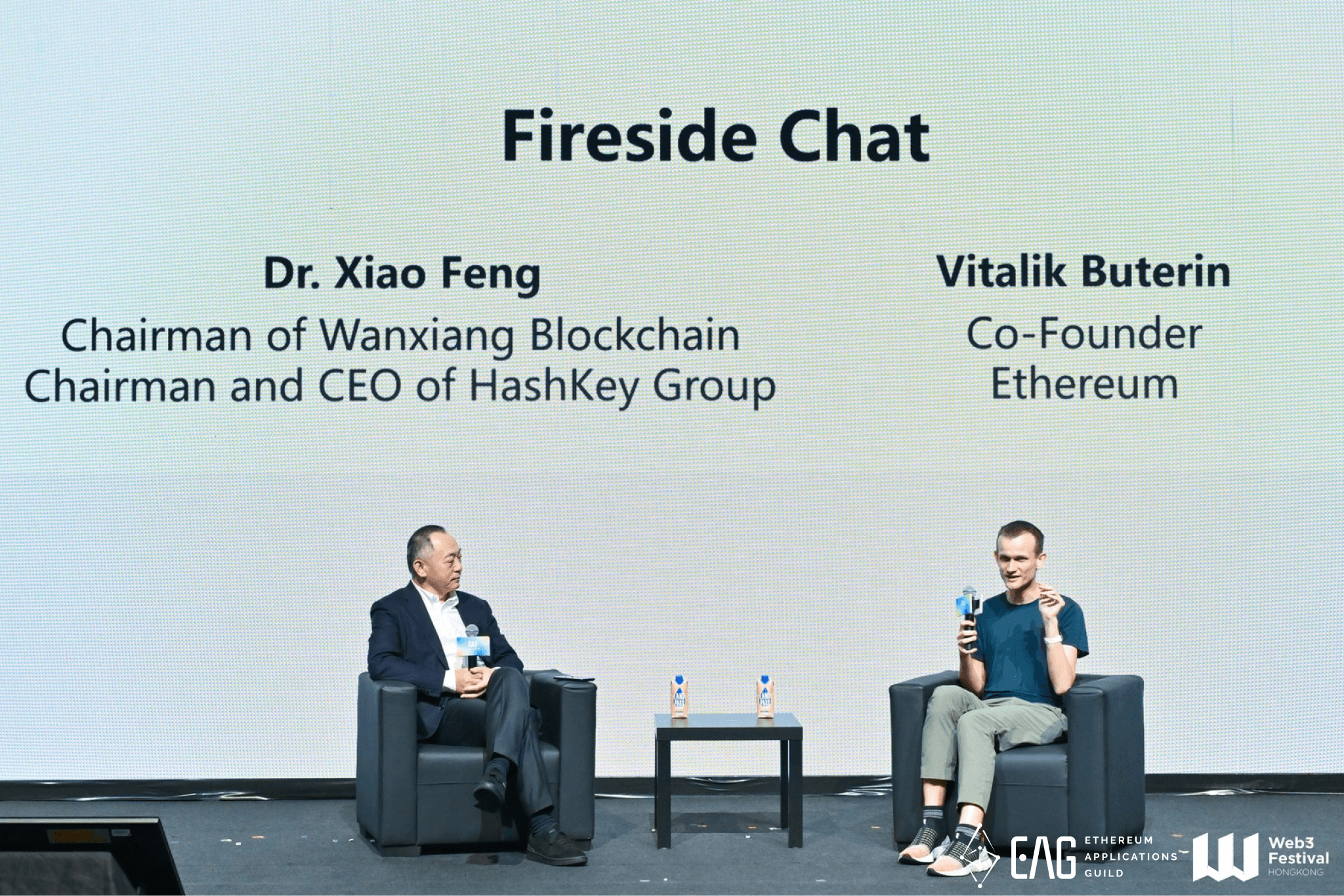
Dr. Xiao Feng believes Ethereum is entering a new phase, shifting from infrastructure development toward real-world application deployment, where the key lies in continuously lowering technical barriers and improving user experience. Drawing on the evolution of the internet and operating systems, he notes that large-scale adoption has historically depended on the simplification of interaction models, from command lines to graphical interfaces and then to mobile applications. In his view, Ethereum will follow a similar path, with wallets, smart contracts, and on-chain interactions becoming more automated and intelligent, while AI and natural language interfaces may eventually allow users to interact with blockchain applications simply by expressing intent in natural language.
At the same time, Ethereum’s development should not focus solely on efficiency, but must continue to uphold its core values of decentralization, security, and user sovereignty. He highlights that the convergence of AI, privacy-preserving computation, and blockchain is opening new possibilities for real-world use cases such as healthcare and data collaboration, while technologies like zero-knowledge proofs, fully homomorphic encryption, and post-quantum cryptography are gradually moving toward practical application. In this context, Layer 1 should remain focused on security and decentralization, while Layer 2 and the application layer address diverse performance and functional needs across different scenarios.

The Ethereum Application Gathering concluded successfully in Hong Kong. As Ethereum’s core infrastructure continues to mature, the application layer is emerging as the key driver of the ecosystem’s next phase of growth. The official launch of the Ethereum Application Guild (EAG) also marks the formation of an open and collaborative global network for builders. Looking ahead, as more real-world applications are deployed and cross-disciplinary integration accelerates, the Ethereum application ecosystem is expected to further expand its reach into the broader real world.